Six checks any owner can make on site, without an engineering degree, that catch the majority of structural quality problems.
You do not need to be an engineer to catch the most common structural problems on a site. You need to know six things to look at, and to look at them before the concrete is poured, because afterwards nothing can be checked without breaking something.
1. The steel diameter
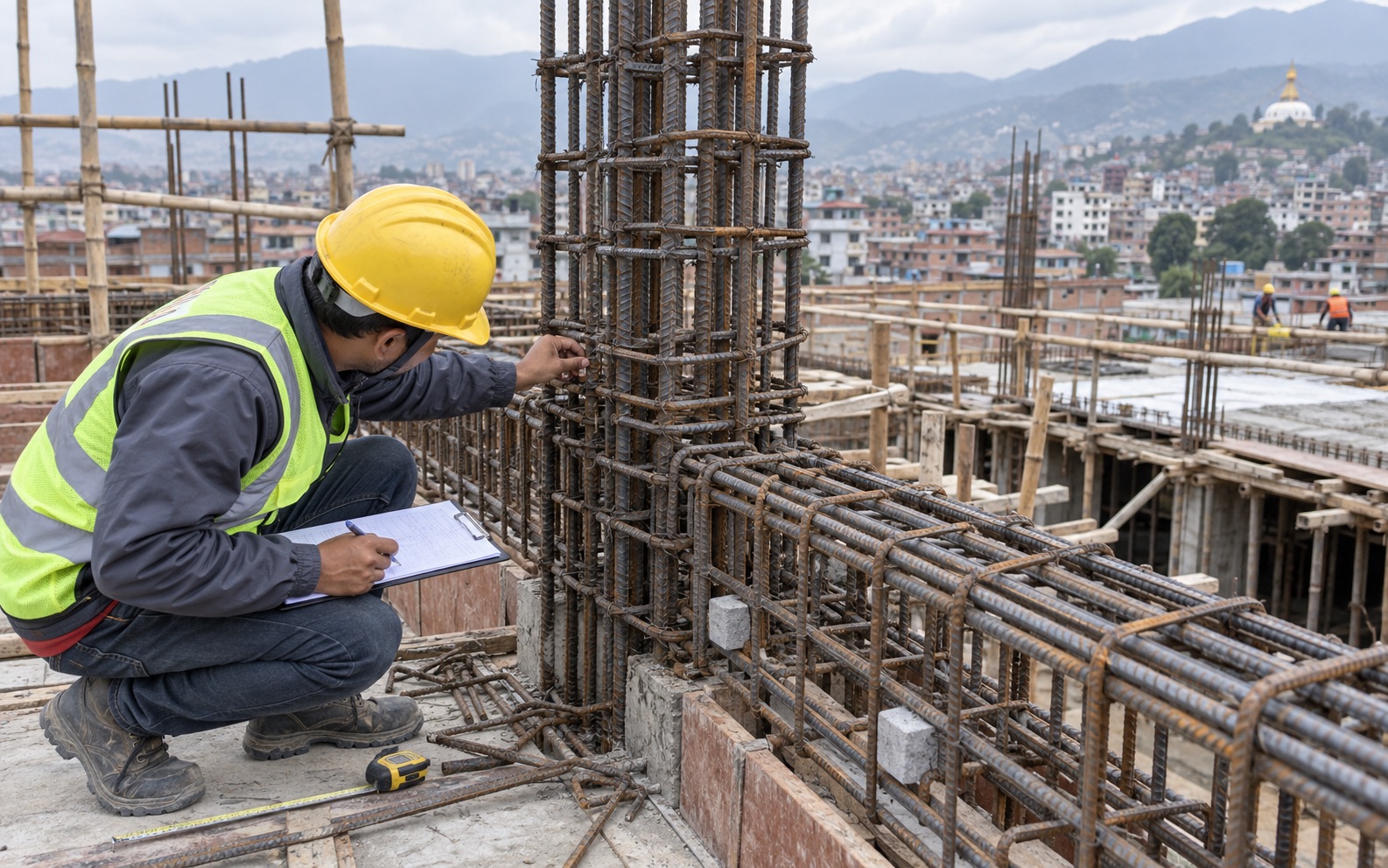
Bars are marked, and the drawing states what should be there. A 16 mm bar where the drawing says 20 mm is a serious reduction in capacity, and it is not visible once the concrete covers it. Ask to see the bar bending schedule and compare it to what is tied on site.
2. The spacing of stirrups
Stirrups are the small rectangular ties around the main bars. Near the ends of beams and columns they must be closer together, because that is where earthquake forces concentrate. Widely and evenly spaced stirrups throughout a column is a warning sign.
3. Cover
Cover is the distance between the steel and the outside face of the concrete. Too little and the steel rusts within a decade, splitting the concrete off. Cover blocks, small spacers between the steel and the formwork, should be visible everywhere before a pour. If the steel is resting on the formwork, stop the pour.
4. Concrete grade and cube tests
M20 and M25 are common for residential work. The grade only means something if it is tested: cubes are cast at the pour, cured, and crushed at seven and twenty eight days. If nobody is casting cubes, nobody knows what grade you received.
5. Water added at the last moment
Adding water at the site to make concrete easier to place is the single most common way strength is lost. Concrete that flows like soup has too much water. The fix for stiff concrete is a plasticiser, not a hose.
6. Curing
Concrete gains strength through a chemical reaction that needs water. A slab that dries out in the first week can lose a significant part of its strength permanently. Curing means keeping surfaces wet for at least seven days, and it costs almost nothing except attention.
Every one of these checks happens before the pour. Once concrete is placed, the only honest test is a destructive one.
If your contractor is unwilling to let you look at reinforcement before a pour, that unwillingness is the finding.